


Page 668 - TNFlipTest
P. 668
 MG10 Medical Genetics
References
Toronto Notes 2019
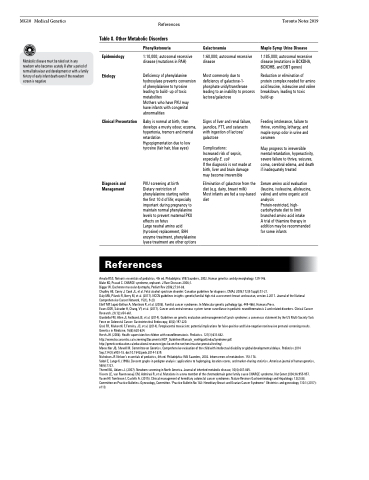
Table 8. Other Metabolic Disorders
    Metabolic disease must be ruled out in any newborn who becomes acutely ill after a period of normal behaviour and development or with a family history of early infant death even if the newborn screen is negative
Epidemiology Etiology
Clinical Presentation
Diagnosis and Management
Phenylketonuria
1:10,000; autosomal recessive disease (mutations in PAH)
Deficiency of phenylalanine hydroxylase prevents conversion of phenylalanine to tyrosine leading to build- up of toxic metabolites
Mothers who have PKU may have infants with congenital abnormalities
Baby is normal at birth, then develops a musty odour, eczema, hypertonia, tremors and mental retardation
Hypopigmentation due to low tyrosine (fair hair, blue eyes)
PKU screening at birth
Dietary restriction of phenylalanine starting within the first 10 d of life; especially important during pregnancy to maintain normal phenylalanine levels to prevent maternal PKU effects on fetus
Large neutral amino acid (tyrosine) replacement, BH4 enzyme treatment, phenylalanine lyase treatment are other options
Galactosemia
1:60,000; autosomal recessive disease
Most commonly due to deficiency of galactose-1- phosphate uridyltransferase leading to an inability to process lactose/galactose
Signs of liver and renal failure, jaundice, FTT, and cataracts with ingestion of lactose/ galactose
Complications:
Increased risk of sepsis, especially E. coli
If the diagnosis is not made at birth, liver and brain damage may become irreversible
Elimination of galactose from the diet (e.g. dairy, breast milk) Most infants are fed a soy-based diet
Maple Syrup Urine Disease
1:185,000; autosomal recessive disease (mutations in BCKDHA, BCKDHB, and DBT genes)
Reduction or elimination of protein complex needed for amino acid leucine, isoleucine and valine breakdown, leading to toxic build-up
Feeding intolerance, failure to thrive, vomiting, lethargy, and maple syrup odor in urine and cerumen
May progress to irreversible mental retardation, hyperactivity, severe failure to thrive, seizures, coma, cerebral edema, and death if inadequately treated
Serum amino acid evaluation (leucine, isoleucine, alloleucine, valine) and urine organic acid analysis
Protein-restricted, high- carbohydrate diet to limit branched amino acid intake
A trial of thiamine therapy in addition may be recommended for some infants
  References
Amato RSS. Nelson’s essentials of pediatrics, 4th ed. Philadelphia: WB Saunders, 2002. Human genetics and dysmorphology. 129-146.
Blake KD, Prasad C. CHARGE syndrome, orphanet. J Rare Diseases 2006;1.
Biggar W. Duchenne muscular dystrophy. Pediatr Rev 2006;27:83-88.
Chudley AE, Conry J, Cook JL, et al. Fetal alcohol spectrum disorder: Canadian guidelines for diagnosis. CMAJ 2005;172(5 Suppl):S1-21.
Daly MB, Pilarski R, Berry M, et al. (2017). NCCN guidelines insights: genetic/familial high-risk assessment: breast and ovarian, version 2.2017. Journal of the National Comprehensive Cancer Network, 15(1), 9-20.
Elieff MP, Lopez-Beltran A, Montironi R, et al. (2008). Familial cancer syndromes. In Molecular genetic pathology (pp. 449-466). Humana Press.
Evans DGR, Salvador H, Chang, VY, et al. (2017). Cancer and central nervous system tumor surveillance in pediatric neurofibromatosis 2 and related disorders. Clinical Cancer Research. 23(12):e54-e61.
Giardiello FM, Allen JI, Axilbund JE, et al. (2014). Guidelines on genetic evaluation and management of Lynch syndrome: a consensus statement by the US Multi-Society Task Force on Colorectal Cancer. Gastrointestinal Endoscopy, 80(2):197-220.
Grati FR, Malvestiti F, Ferreira, JC, et al. (2014). Fetoplacental mosaicism: potential implications for false-positive and false-negative noninvasive prenatal screening results. Genetics in Medicine, 16(8):620-624.
Hersh JH. (2008). Health supervision for children with neurofibromatosis. Pediatrics. 121(3):633-642. http://www.bccancer.bc.ca/screening/Documents/HCP_GuidelinesManuals_vonHippelLindauSyndrome.pdf. http://geneticseducation.ca/educational-resources/gec-ko-on-the-run/non-invasive-prenatal-testing/.
Moeschler JB, Shevell M. Committee on Genetics. Comprehensive evaluation of the child with intellectual disability or global developmental delays. Pediatrics 2014 Sep;134(3):e903-18. doi:10.1542/peds.2014-1839.
Nicholson JF. Nelson’s essentials of pediatrics, 4th ed. Philadelphia: WB Saunders, 2002. Inborn errors of metabolism. 153-178.
Sobel E, Lange K. (1996). Descent graphs in pedigree analysis: applications to haplotyping, location scores, and marker-sharing statistics. American journal of human genetics, 58(6):1323.
Therrell BL, Adams J. (2007). Newborn screening in North America. Journal of inherited metabolic disease, 30(4):447-465.
Vissers LE, van Ravenswaaij CM, Admiraal R, et al. Mutations in a new member of the chromodomain gene family cause CHARGE syndrome. Nat Genet 2004;36:955-957. Vasen HF, Tomlinson I, Castells A. (2015). Clinical management of hereditary colorectal cancer syndromes. Nature Reviews Gastroenterology and Hepatology. 12(2):88. Committee on Practice Bulletins–Gynecology, Committee. "Practice Bulletin No 182: Hereditary Breast and Ovarian Cancer Syndrome." Obstetrics and gynecology 130.3 (2017): e110.


